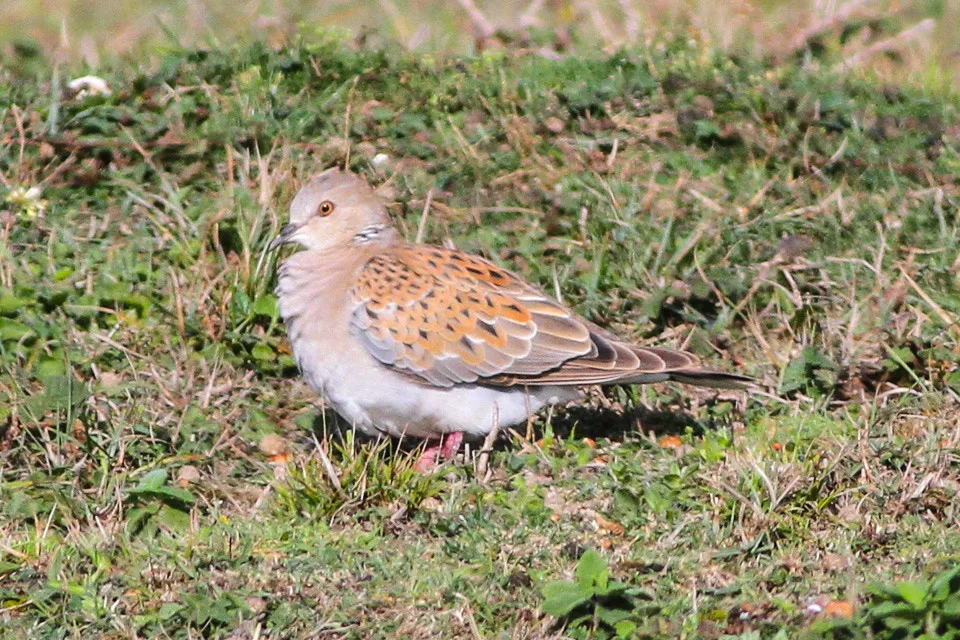

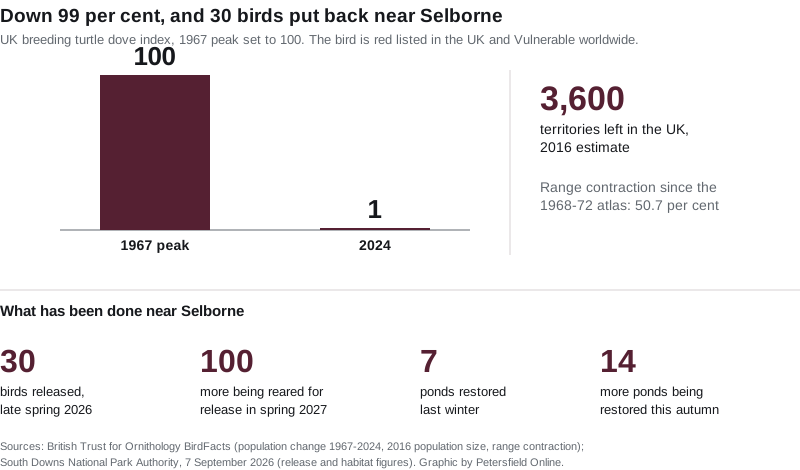
Thirty turtle doves were released near Selborne in spring, and one has already laid eggs. About 100 more are being reared for a release in spring 2027.
Thirty turtle doves were released at an undisclosed site near Selborne in late spring, and they have settled well enough that one of the females has already come back into the release enclosure to lay eggs. The South Downs National Park Authority published the project on 7 September.
Around 100 more birds are being reared in an enclosure nearby, ready for a second release in spring 2027.
Selborne is about six miles north of Petersfield, on the far side of the hangers. It is a village with an unusual claim on this particular bird, and we come back to that below.
What has actually happened
The birds went out in late spring. Since then the National Park’s rangers say they have been churring, laying and flying around the area. They are expected to leave this autumn for sub-Saharan Africa, a journey of about 3,000 miles across France, Spain and Morocco.
The release is a partnership between five parties:
- the landowner, who is part of the Selborne Landscape Partnership and has asked to stay anonymous
- the Selborne Landscape Partnership, a group of farmers and landowners working on the local landscape
- the South Downs National Park Authority
- the Farming and Wildlife Advisory Group for the south east
- the Turtle Dove Trust, which reared the captive-bred birds
Habitat work came first. Turtle doves need shallow fresh water near their nest sites, so seven ponds were restored last winter and another 14 are being restored this autumn in the area around the release. Hedgerows have been managed and scrubby areas left for nesting. The “weedy” wildflowers the birds feed on have been sown: fumitory, birds foot trefoil, vetch, and red and white clover.
Why 30 birds is a bigger number than it sounds
The national record explains the scale of it. The British Trust for Ornithology’s own figures for the turtle dove read as follows:
| Measure | Figure |
|---|---|
| UK breeding population change | −99% (1967 to 2024) |
| UK breeding population size | 3,600 territories (2016) |
| Range contraction | −50.7% |
| UK Birds of Conservation Concern | Red listed |
| IUCN global Red List | Vulnerable |
The BTO puts it bluntly on its own species page: the trends, “unless halted or reversed, would bring the species close to extinction in the UK within the next two decades”. Its atlas work found that more than half the 10km squares occupied in 1968 to 1972 had been lost by 2008 to 2011, with the surviving population pulling back towards East Anglia and Kent.
That is the point about Hampshire. The BTO describes breeding turtle doves as restricted to the eastern half of England, as far north as Yorkshire and west to the Severn. Selborne sits outside that core. Paul Bushell, a ranger for the South Downs National Park, said the western side of the National Park suits the species, being “woodland edge, arable, scrubby, hedgerowed habitat with ponds nearby”, and that the hope is to build “a new and much-needed South Downs stronghold for this red-listed bird”.
He also put the release in context. “We all know the turtle dove from the festive carol, but the truth is they are now far too rare for such a Christmas gift,” he said.
The National Park Authority gives the UK decline as 98 per cent between the species’ peak in the late 1960s and 2023. The BTO’s own trend, run to 2024, rounds to 99 per cent. Both come from the same Common Birds Census and Breeding Bird Survey series, so the difference is the end year, not a disagreement.
Gilbert White listed it, and wrote nothing else about it
Selborne is where Gilbert White kept the notes that became The Natural History of Selborne in 1789, and the turtle dove is in them. In his first letter to Daines Barrington, dated Selborne, 30 June 1769, White set out a numbered list of “the Summer Birds of Passage which I have discovered in this neighbourhood”. Number 13 is the turtle-dove.
It is the only one of the twenty entries with nothing written beside it. Every other line carries an arrival date or a description of the bird’s song: the nightingale at the beginning of April, the swift “about April 27”, the grasshopper-lark’s “small sibilous note, till the end of July”. Against the turtle-dove there is a name and then blank space. In the other list White made of the same birds, the entry carries a question mark.
So the record at Selborne starts with a bird its most famous observer could confirm was there and little more. The National Park Authority calls the village White’s old stomping ground, and William Selborne, who chairs the Selborne Landscape Partnership, said it was “wonderful to hear this iconic bird back in the Selborne landscape after so long an absence”.
What it means for you
If you think you have seen or heard one, report it. The National Park is plotting public sightings on a map, and expects more of them when the birds return next spring. The male’s churring is the giveaway and carries a long way.
A turtle dove record here is not an ordinary record. The BTO notes that the species has been added to the Rare Breeding Birds Panel’s list, and that all breeding records since 2018 should be submitted to the panel. Bird records that sit in a notebook do not count towards anything.
Do not go looking for the release site. The location has not been published, deliberately, and the remaining birds are in an enclosure on private land.
The season is nearly over anyway. Turtle doves are summer visitors, here from about mid-April to the end of August or the start of September, and this year’s 30 are expected to leave for Africa shortly. The realistic window for hearing one locally is next spring.
Look for the right bird. A turtle dove is smaller and darker than a collared dove and slightly larger than a blackbird, with chestnut and black mottling on the back and a black tail with a white edge.
Related
- Butser Hill: £160,000 to restore 48 hectares for butterflies, the other big habitat project on Petersfield’s doorstep.
- Things to do in Petersfield, including the walks up onto the hangers.
Sources
- South Downs National Park Authority, “South Downs National Park brings turtle dove back from the brink”, 7 September 2026, for the release of 30 birds near Selborne, the egg-laying female, the 100 birds held for spring 2027, the seven ponds restored and 14 more planned, the wildflower planting, the partners and all quotations from Paul Bushell, William Selborne and Robert Anderson-Brown.
- British Trust for Ornithology, BirdFacts: Turtle Dove, for the 99 per cent population change from 1967 to 2024, the 3,600-territory population estimate for 2016, the 50.7 per cent range contraction, the Red and Vulnerable listings, the two-decade extinction warning, the atlas range loss between 1968-72 and 2008-11, the eastern England breeding range and the Rare Breeding Birds Panel reporting requirement.
- Gilbert White, The Natural History of Selborne, Letters to Daines Barrington, Letter I, dated Selborne, 30 June 1769, for the list of summer birds of passage and the turtle-dove entry. Read in the Project Gutenberg text.
Have your say